
Wayne County Court Records After a Jail Arrest
After a Wayne County jail arrest, the first local record is usually the booking or jail-docket entry kept by the Wayne County Sheriff's Office and Adult Detention Center. That entry can show the warrant or mittimus, the name of the prisoner, the date of arrest and commitment, the listed cause for custody, and the way the person was released, discharged, or transferred. It is a custody record. It does not decide guilt, and it may not match the final court charge.
The court record begins when a charge is filed or processed in the correct court. Wayne County Circuit Court is part of Mississippi's 10th Circuit and handles felony criminal prosecutions. Justice Court handles lower-level matters within its jurisdiction and can issue warrants. The District Attorney, Kassie Coleman, prosecutes felony matters for the 10th Circuit Court District. For the custody side of the same event, use jail inmate records. For booking photos and the limits on requesting them, use jail mugshots.
How to Find Wayne County Court Records After an Arrest
The most reliable path starts by separating the jail question from the court question. Call the Wayne County Sheriff's Office at 601-735-3801 if the immediate issue is custody, booking date, bond shown at the jail, or release. For filed charges, case numbers, court dates, warrants tied to a court case, or dispositions, contact the clerk for the court with jurisdiction. The Wayne County courts page lists Circuit Clerk Kathryn "K.K." Revette at the Wayne County Courthouse, first floor, 609 Azalea Drive, Waynesboro, MS 39367, phone 601-735-1171, fax 601-735-6261.
- Confirm the booking name, arrest date, and arresting agency with the jail when custody status is still unclear.
- Identify the likely court. Felony prosecutions generally move through Circuit Court, while lower-level or warrant matters may involve Justice Court at 814 Chickasawhay Street.
- Search Mississippi Electronic Courts at courts.ms.gov/mec/mec.php if access is available. MEC may require registration or login for full case access.
- Ask the Circuit Clerk or Justice Court clerk to search by defendant name, case number, arrest date, citation, or warrant information.
- Compare each court charge with the jail booking language before relying on the result.
The Mississippi Electronic Courts portal is the official statewide portal for electronic court access in Mississippi.
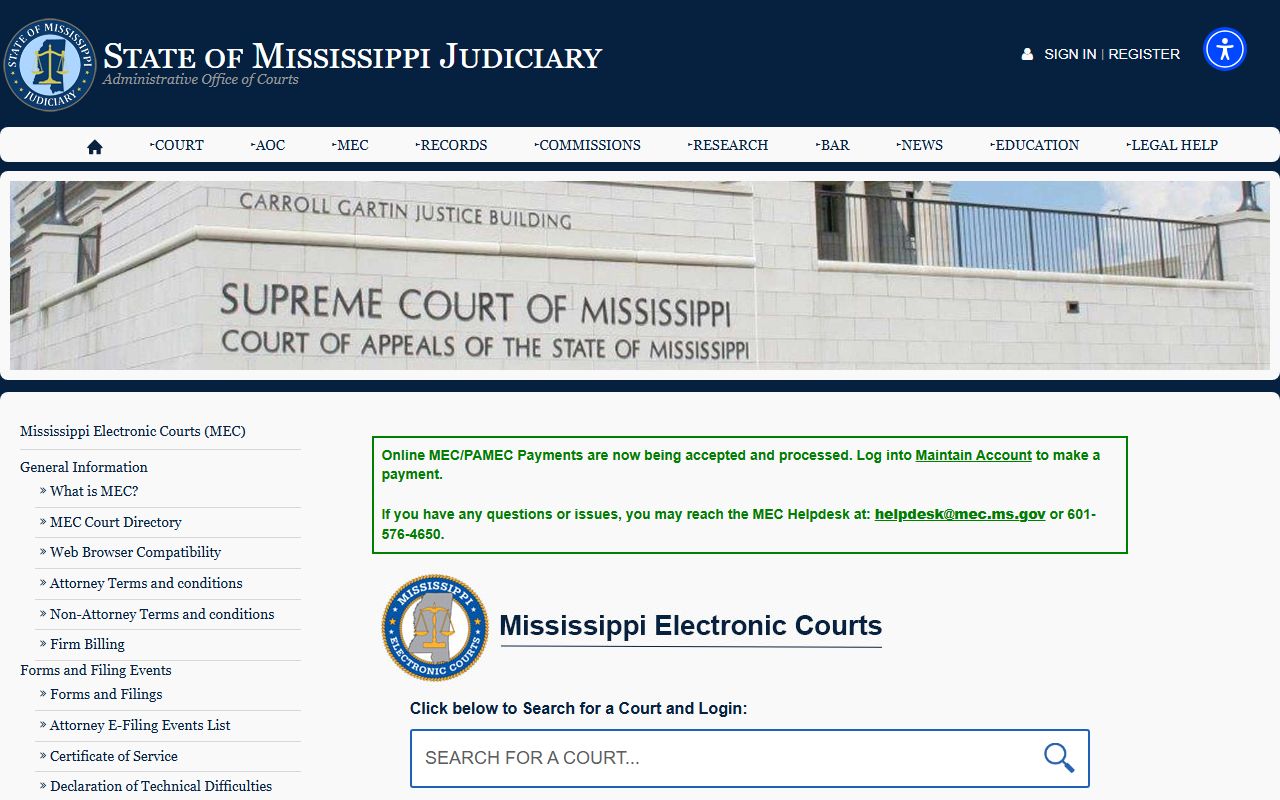
For Wayne County court records after a jail arrest, MEC is useful when the case is available through the portal, while the local clerk remains the fallback for access limits and case-number help.
MEC is the statewide court access channel, but the local clerk remains important because not every requester has portal credentials and some details may require clerk assistance, in-person inspection, mail request, or attorney access. Statewide criminal-history searches are a different channel from a Wayne County court case. They may involve fees, identification, fingerprints, or separate state procedures, so they should not be treated as a substitute for the local court file.
How Charges Get Filed After an Arrest: Complaint, Information, and Indictment
A booking charge is often the arresting officer's first description of why someone was taken to jail. A court charge is the accusation actually filed or pursued in court. In Wayne County, the District Attorney handles felony prosecution in Circuit Court and may proceed with different charge language than the jail first recorded. Charges can be amended, reduced, dismissed, or presented to a grand jury as the case develops.
| Complaint | Information | Indictment | |
|---|---|---|---|
| Filed By | Officer, affiant, or prosecutor depending on the matter. | Prosecutor when allowed by law and procedure. | Grand jury after felony review. |
| Common For | Initial lower-court cases, affidavits, and warrant-supported matters. | Cases a prosecutor files without waiting for an indictment when legally available. | Serious felony prosecutions in Circuit Court. |
| Starts | A court file or warrant process tied to the alleged offense. | The formal prosecution on stated counts. | The Circuit Court felony case on the counts returned. |
Charge Status in Court Records After an Arrest
Charge status is the working condition of each count in the court record. A person can have more than one count, and each count may have a different status. One charge may remain pending while another is dismissed. A jail roster or jail docket may still show the original arrest reason even after the prosecutor files a narrower, broader, or different charge in court.
| Status | What It Means |
|---|---|
| Pending | The charge remains open. No final disposition has been entered for that count. |
| Amended / Reduced | The filed charge changed, often because the prosecutor, court, plea process, or evidence narrowed the accusation. |
| Dismissed | The court record shows the count was terminated without a conviction on that charge. |
| Nolle Prosequi | The prosecutor formally declined to proceed on that charge, commonly shortened to nolle pros. |
| Convicted / Guilty Plea | The case ended in a conviction by verdict or plea, subject to sentencing and later post-case orders. |
Bond and Release After an Arrest
Wayne County did not publish a jail-specific bond page in the sources located. Bond is usually controlled by the court or judicial officer with jurisdiction over the charge, not by a private website. The jail may be able to confirm whether a bond amount is listed, but the court may have the most current charge, bond type, court date, or hold information. Before paying anyone, confirm the person's full booking name, charge, court, bond type, and any holds with the jail and the proper clerk.
| Bond Type | How It Works |
|---|---|
| Cash Bond | The full amount is paid to secure appearance. Ask the jail or court who accepts payment and when. |
| Surety Bond | A licensed bail agent posts the bond for a fee and will need exact court and jail information. |
| Property Bond | Property is used as security where allowed, usually requiring court approval and documentation. |
| PR / Own Recognizance | The person is released on a promise to appear, depending on the judge, charge, and circumstances. |
| No-Bond Hold | A court order, detainer, probation or parole hold, federal hold, ICE detainer, DOC transfer hold, or another warrant blocks release. |
Warrants That Lead to an Arrest
Wayne County has a sheriff Most Wanted page and a tip page, but no official active warrant-search database was located. The Most Wanted page existed during research, but no visible active entries were found. Warrant information may sit with the sheriff, Justice Court, Circuit Court, Waynesboro municipal authorities, or another agency depending on the type of warrant. Justice Court clerks and deputy clerks can issue warrants and acknowledge affidavits for Justice Court. Circuit Court processes warrants, summonses, and subpoenas in felony and circuit matters.
For warrant questions, call the Wayne County Sheriff's Office at 601-735-3801, Justice Court at 601-735-3118, or the Circuit Clerk at 601-735-1171. Waynesboro/Wayne County Crime Stoppers lists PO Box 1446, Waynesboro, MS 39367, contact Enis King, 601-735-3124, and tip line 601-735-LEAD for tips. Anyone who believes a warrant may exist should consider speaking with an attorney or the issuing court before appearing in person, because an active warrant can lead to arrest.
Charges vs. Convictions
An arrest and a filed charge are accusations. A conviction is a final result reached by guilty plea, verdict, or other court finding. Wayne County court records after an arrest may show charges that never become convictions, charges reduced through plea negotiation, or counts dismissed by the court or prosecutor. That distinction matters for employment, housing, licensing, immigration, bond decisions, and record-clearing questions.
| Charge | Conviction | |
|---|---|---|
| Stage | Accusation after arrest, complaint, information, or indictment. | Final outcome by plea, verdict, or judgment. |
| Burden of Proof | Lower early-stage standards such as probable cause may support arrest or filing. | Criminal conviction requires proof beyond a reasonable doubt or a valid guilty plea. |
| Public Record | Often public unless sealed, juvenile, restricted, or exempt. | Often public unless expunged, sealed, or otherwise restricted by law or court order. |
| Practical Use | Should be read as an allegation, not proof that the person committed the offense. | May affect sentence, supervision, custody transfer, and record history. |
Sealed vs. Expunged Arrest Records
Mississippi Code Section 99-19-71 provides expunction routes for eligible criminal records, including certain convictions and arrests that were dismissed, dropped, not disposed, or ended in not guilty. Expunction is not automatic for every arrest, and a person usually needs a court order. A dismissal in the court record does not by itself guarantee that every jail, court, state, or third-party copy disappears.
| Sealed | Expunged | |
|---|---|---|
| Visibility | Restricted from ordinary public access by law or court order. | Removed or treated as cleared from official public records where the order applies. |
| Law Enforcement | Some limited official access may remain depending on the order and record type. | Access is more restricted, but the exact effect depends on Mississippi law and the court order. |
| Eligibility | Juvenile, protected, or court-restricted matters may be sealed. | Section 99-19-71 covers eligible dismissed, dropped, no-disposition, not-guilty, and certain conviction records. |
| Next Step | Ask the clerk or attorney what order restricts the record. | Use the court that handled the case and follow the expunction order process. |
Background Check Considerations
Casual court lookup is not the same as a legally compliant background check. A Wayne County case file may show arrests, charges, dispositions, and court dates, but it may omit statewide records, federal records, sealed records, or corrected records from another system. Anyone using criminal-history information for employment, tenant screening, credit, insurance, licensing, or another regulated decision should use a lawful process designed for that purpose.
Important: This website is not a consumer reporting agency and cannot be used for FCRA-covered screening decisions.
Restricted Court Records After an Arrest in Wayne County
Not every record connected to an arrest is public. Youth Court records are not open to the public and are sealed according to the Wayne County courts page. Juvenile records, sealed cases, expunged matters, medical details, security details, victim information, witness information, informant information, and active investigative material may be withheld or redacted. Mississippi's Public Records Act treats incident-report basics differently from investigative reports, and investigative records can be protected when release would interfere with prosecution, reveal confidential sources, disclose techniques, or endanger safety.
The safe approach is to ask for the specific record by name and accept that the custodian may redact or deny exempt portions in writing. For jail records, the custodian is generally the sheriff's office at 613 Court Street, with local contact details also listed on the sheriff's official contact page. For court records, start with the Circuit Clerk, Justice Court clerk, MEC, or the attorney of record. For felony prosecution questions, the District Attorney's Office for the 10th Circuit is at 612 22nd Avenue South, Meridian, MS 39301, phone 601-482-9757, email da10@lauderdalecounty.org.